
 1. Quantifying the duration and functional significance of long-term stored water in trees and forests
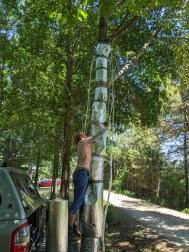
Accurate modeling of water storage and fluxes in both natural and human-altered ecosystems is critical to managing global water resources under current-day and projected future climates. Yet, modelled water-storage at the watershed scale frequently underestimate satellite observations because of a mechanistic lack of understanding of how trees manage water storage and transport at daily to monthly timescales. Characterizing the duration of water storage and its impacts on tree ecohydrology are critical for improving hydrological models.
Using novel, in situ stable isotope methods, combined with a vast array of sensors measuring water amount and movement in trees, we are characterizing the dynamics of long-term stored water in trees.
2. Climate change and altitudinal treeline stability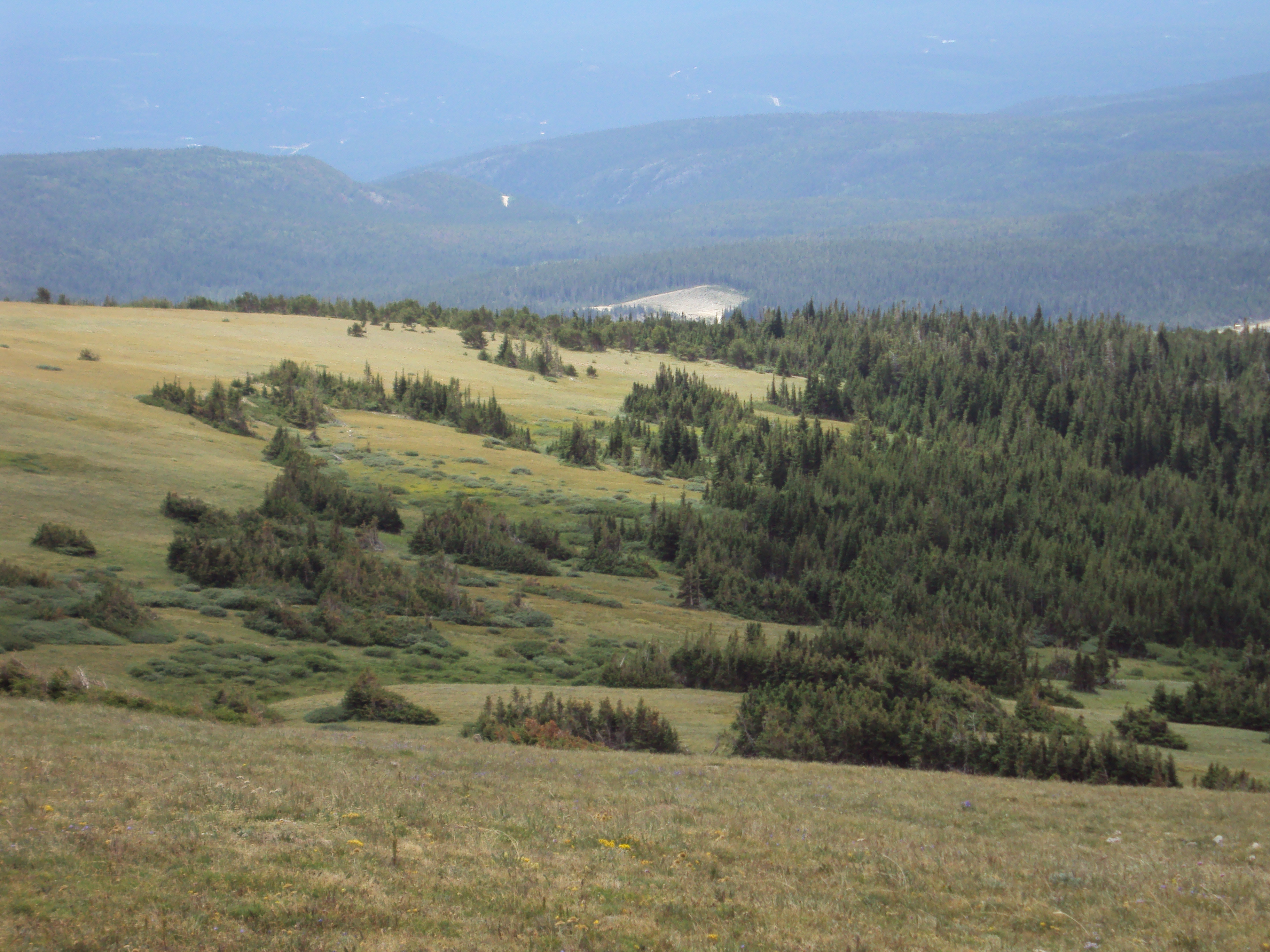
Warming temperatures due to climate change are predicted to cause increases in the altitude of aline treelines. Mechanistically, this can occur only via successful recruitment of tree seedlings into alpine meadows. Our research projects focus on understanding abiotic, biotic, and genetic limitations to seedling carbon balance, establishment, and survival in high elevations. Our research is revealing that successful seedling establishment depends not only on positive carbon balance but also on escaping critical water-relations thresholds. We are finding also that juvenile seedlings express adaptive traits that enhance carbon gain (e.g., increased specific leaf area), even at the expense of exposure to harsh environmental conditions.
 3. Ecophysiology of trees and shrubs in Southern Appalachian cloud forests
Cloud forests are pandemic, and are characterized by sharp vegetation boundaries that co-occur with sharp cloud gradients. Because climate change is predicted to alter cloud type, frequency, and altitude of occurrence, understanding how plant ecophysiology varies due to cloud cover is vital for predicting changes in cloud-forest plant species’ range limits in the future. The Southern Appalachian spruce-fir ecosystem is a model system for quantifying couplings between vegetation and cloudiness. This sky-island ecosystem is enshrouded in cloud fog 30-40% of a typical summer day, with cloud immersion occurring on as much as 60% of all days annually. My dissertation research focused on comparing differences in carbon and water relations due to sky condition (i.e., sunny, low-cloud, cloud-immersed) in both tree (Abies fraseri, Picea rubens) and shrub (Rhododendron catawbiense) species. We found that while photosynthesis increased under cloudy skies, cloud-immersion resulted in greatly reduced carbon gain in all species, underscoring a carbon-limited ecosystem where evergreen species might outcompete broadleaved species. We also found that cloudy conditions resulted in substantial changes in light directionality (direct vs. diffuse) and spectral quality (specifically, ratios of blue:red, blue:total sunlight, and red:far red), that benefit photosynthesis. Hydraulic constraints in conifers may also be causative factors limiting species’ range limits in these cloud forests.

Downplot photo, INL ecohydro
4. Effects of experimentally altered hydro-climate on semi-arid shrub communities
In western North America, changes in the seasonality of precipitation are predicted due to climate change. This will have strong impacts on plant ecophysiology and ecosystem functioning in water-limited ecosystems. We have been quantifying how these irrigation treatments affect ecophysiology, ecohydrology, population biology, and ecosystem processes in shrub-dominatedcommunities. Our results are showing that changes in precipitation seasonality do affect productivity and water use in shrubs at both individual- and population-level scales, but changes are contingent on soil depth. Plant and population responses may result from a combination of edaphic factors (anaerobic soil conditions) and organism-level water balance (i.e., balance of maximum productivity with hydraulic constraints). Also, we’re interested in studying coupled nitrogen-carbon-water processes in this ecosystem, as belowground processes may have greater effects on shrub productivity than changes in aboveground carbon fluxes.
 5. Ecohydrological controls of shrubs and trees on terrestrial carbon cycling
We are a member of a team of interdisciplinary scientists at Idaho State University, Boise State University, and USDA ARS that joined to form the new Reynold’s Creek Critical Zone Observatory (RCCZO-http://criticalzone.org/reynolds/). RCCZO is devoted to the quantification of soil carbon processes to address the grand challenge of improving prediction of soil carbon storage and flux from the pedon to the landscape scale. RCCZO is located in the Reynolds Creek Experimental Watershed in southwestern Idaho.
As our component of the collaborative research, we are investigating leaf to canopy scale controls on water and carbon fluxes along an elevation gradient using leaf-level gas exchange, sap flux, and canopy-scale ecosystem exchange measurements.
 Keith Reinhardt